The passenger compartment of the 2020 Audi Q7 remained stable in the frontal offset test. Dummy readings indicated good protection of the knees
and femurs of both the driver and passenger.
Audi showed that a similar level of protection would be provided to occupants of different sizes and to those sitting in different positions. Protection of the chest was marginal for both driver and passenger.
In the full-width rigid barrier test, chest protection was again marginal for the rear passenger but other critical body areas were well or adequately protected, for both occupants.
In both the side barrier test and the pole impact, protection of all critical body areas was good and the Audi Q7 scored maximum points in these tests.
Tests on the front seats and head restraints demonstrated good protection against whiplash injuries in the event of a rear-end collision.
A geometric assessment of the front seats also indicated good whiplash protection.
The standard-fit autonomous emergency braking (AEB) system performed well in tests of its functionality against other vehicles at the low speeds, typical of city driving, at which many whiplash injuries occur, with collisions avoided in almost all test scenarios.
2020 Renault Captur Crash Safety Tests Results
The passenger compartment of the Renault Captur remained stable in the frontal offset test.
Dummy readings indicated good protection of the knees and femurs of the driver and passenger.
Renault showed that a similar level of protection would be provided to occupants of different sizes and to those sitting in different positions.
Protection was rated as good for all critical body areas for the passenger.
In the full-width rigid barrier test, protection was good or adequate for all critical body areas, both for the driver and the rear passenger.
In the side barrier impact, protection of all critical body areas was good and the car scored full points in this test.
Even in the more severe side pole test, protection of the chest was adequate and that of other body regions was good.
Tests on the front seats and head restraints demonstrated good protection against whiplash injuries in the event of a rear-end collision.
A geometric assessment of the rear seats also indicated good whiplash protection.
The standard-fit autonomous emergency braking (AEB) system performed well in tests of its functionality at the low speeds at which many whiplash injuries occur, with collisions avoided in most test scenarios.
The stand-out performer of this round is undoubtedly Tesla’s Model X, scoring 94 percent for Safety Assist, the same as the Model 3 scored early this year.
The passenger compartment of the Model X remained stable in the frontal offset test. Dummy readings indicated good protection of the
knees and femurs of the driver and passenger.
Tesla showed that a similar level of protection would be provided to occupants of different sizes and to those sitting in different positions. Protection was rated as good for all critical body areas for the driver.
This was also the casein the the full-width rigid barrier test, and protection was good or adequate for the rear passenger. In both the side barrier and the more severe side pole tests, protection of all critical body areas was good and the car scored full points in both of these tests.
Tests on the front seats and head restraints demonstrated good protection against whiplash injuries in the event of a rear-end collision. A geometric assessment of the rear seats also indicated good whiplash protection.
The standard-fit autonomous emergency braking (AEB) system performed well in tests of its functionality at the low speeds at which many whiplash injuries occur, with collisions avoided in all test scenarios.
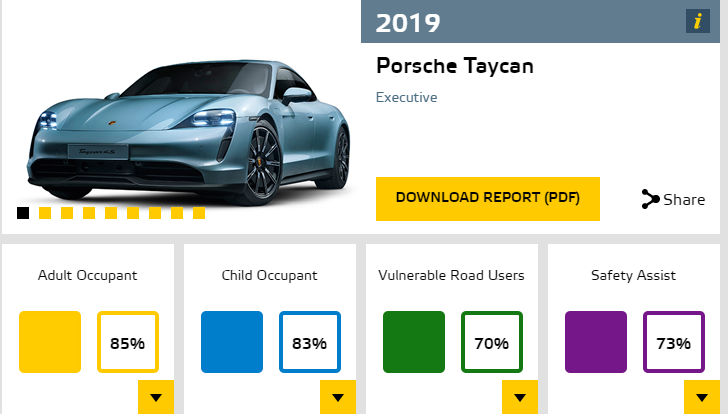
2020 Porsche Taycan Crash Safety Tests Results
The passenger compartment of the Taycan remained stable in the frontal offset test. Dummy readings indicated good protection of the
knees and femurs of the driver and passenger.
Porsche showed that a similar level of protection would be provided to occupants of different sizes and to those sitting in different positions.
In the full-width rigid barrier test, protection of all critical body areas was good or adequate for both occupants, with the exception of the rear passenger's chest, for which dummy readings of compression indicated a marginal level of protection.
In the side barrier impact, protection of all critical body areas was good and the car scored full points in this tests.
In the more severe side pole test, protection of the chest was adequate and that of other body areas was good.
Tests on the front seats and head restraints demonstrated marginal protection against whiplash injuries in the event of a rear-end collision. A geometric assessment of the rear seats also indicated marginal whiplash protection.
The standard-fit autonomous emergency braking (AEB) system performed well in tests of its functionality at the low speeds at which many whiplash injuries occur. However, the Taycan was not awarded the points for these tests as good dynamic performance in the front seats is a prerequisite for AEB scoring.
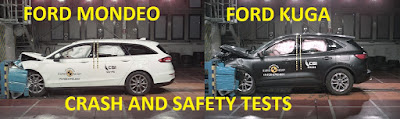
The passenger compartment of the Mondeo remained stable in the frontal offset test. Dummy readings indicated good protection of the knees and femurs of the driver and passenger.
Ford showed that a similar level of protection would be provided to occupants of different sizes and to those sitting in different positions. In the full-width rigid barrier test, protection of all critical body areas was good or adequate for both the driver and rear passenger.
In both the side barrier and the more severe side pole tests, protection of all critical body areas was good and the car scored full points in both of these tests.
Tests on the front seats and head restraints demonstrated good protection against whiplash injuries in the event of a rear-end collision. A geometric assessment of the rear seats also indicated good whiplash protection.
The standard-fit autonomous emergency braking (AEB) system performed well in tests of its functionality at the low speeds at which many whiplash injuries occur.
2020 Ford Kuga crash tests results
The passenger compartment of the Kuga remained stable in the frontal offset test. Dummy readings indicated good protection of the
knees and femurs of the driver and passenger.
Ford showed that a similar level of protection would be provided to occupants of different sizes and to those sitting in different positions. Protection of the driver's chest and lower leg was rated as marginal. In the full-width rigid barrier test, protection the driver's chest was again marginal but that of all other critical body areas was good or adequate for both the driver and rear passenger.
In both the side barrier and the more severe side pole tests, protection of all critical body areas was good and the car scored full points in both of these tests.
Tests on the front seats and head restraints demonstrated good protection against whiplash injuries in the event of a rear-end collision. A geometric assessment of the rear seats also indicated good whiplash protection.
The standard-fit autonomous emergency braking (AEB) system performed well in tests of its functionality at the low speeds at which many
whiplash injuries occur
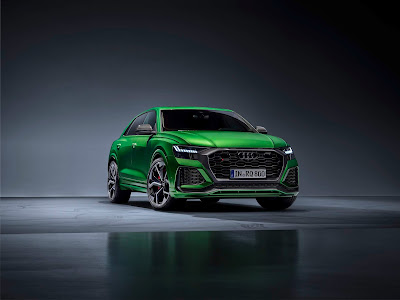
The new Audi RS Q8 (joined fuel utilization in l/100 km: 12.1 (19.4 US mpg); consolidated CO2 outflows in g/km*: 277 - 276 (445.8 – 444.2 g/mi)) is the top model in the Q product offering.
It joins the intensity of a RS model with the style of a superior car and the adaptability of a SUV. The new Audi RS Q8** will land at vendors in Germany and other European nations during the principal quarter of 2020. Costs in Germany for the lively SUV car start at 127,000 euros.
"Without precedent for the 25-year history of Audi RS models, we are putting a huge SUV car with the qualities of a genuine superior games vehicle out and about," said Oliver Hoffmann, Managing Director of Audi Sport GmbH. "With its biturbo V8 fuel motor, the Audi RS Q8** is the lofty initiate of the RS model family."
Ready for anything: the suspension
The five-link construction at the front and rear axles handle longitudinal and lateral forces separately. The linkages and the subframes are made largely of aluminum.
The SUV coupe has a track of 1,692 millimeters (5.55 ft) up front and 1,696 millimeters (5.56 ft) at the rear.
The standard adaptive air suspension sport with controlled damping means the new RS Q8** is equally at home on the racetrack or an offroad trail. Its RS-specific damper tuning allows for a particularly broad spread between a setup biased toward comfort and an extremely sporty setup. Depending on driving situation and the driver’s wishes, the body’s ride height varies by up to 90 millimeters (3.5 in).
The optional electromechanical active roll stabilization (EAWS) minimize body roll during fast cornering. There is a compact electric motor between the two halves of the stabilizer on each of the two axles. When driving straight ahead, the two halves of the stabilizer are decoupled, which reduces body movement on uneven roads and also increases ride comfort. During cornering, however, the focus is on optimum roll compensation. The halves of the stabilizer are twisted in opposite directions, which significantly reduces vehicle lean while cornering.
The electromechanical active roll stabilization is integrated in the 48-volt main electrical system and serves as a recuperating system. It can even recover power via the electric motors and thereby feed electrical energy back to the battery.
With the optional dynamic package plus with the electronically governed top speed of 305 km/h (189.5 mph), customers also get a chassis designed for maximum sportiness.
This includes electromechanical active roll stabilization, the quattro sport differential and the RS ceramic brake system.
The standard all-wheel steering moves the rear wheels via a high-torque electric spindle drive and two track rods. At low speeds, the rear wheels turn up to 5 degrees opposite the direction of the front wheels for greater agility.
At high speeds, they turn up to 1.5 degrees in the same direction as the front wheels to improve stability during fast lane changes.
With variable ground clearance, short overhangs, quattro permanent all-wheel drive and hill descent control, the new Audi RS Q8** can carry on calmly and confidently when paved roads end.
The driver can precisely influence the character of the RS Q8** via the Audi drive select dynamic handling system.
There are eight profiles from which to choose: comfort, auto, dynamic, efficiency, allroad, offroad and the individually configurable RS-specific modes RS1 and RS2, which can be activated directly via the “RS-MODE” button on the steering wheel.
Audi drive select affects such things as engine and transmission management, steering boost, the air suspension, all-wheel steering, engine sound and the characteristic of the automatic air conditioning.
The new RS Q8** comes standard with 22-inch aluminum wheels in a 10-spoke star design with 295/40-series tires – the largest ever factory-installed on an Audi production model.
Optional 23-inch cast aluminum wheels in a 5 Y-spoke rotor design and a variety of colors are available exclusively for the RS Q8**. Behind the large wheels is an RS brake system with internally vented composite disks (420 millimeters (16.5 in) up front, 370 millimeters (14.6 in) at the rear).
Their 10-inch piston calipers are painted black as standard, but are available in red as an option.
The calipers of the optional RS ceramic brakes are available in gray, red or blue and measure 440 millimeters (17.3 in) up front and 370 millimeters (14.6 in) at the rear.
Self-confident: the exterior
With its imposing octagonal Singleframe, the RS-specific radiator grille in high gloss black and the gloss black RS honeycomb grille, the new Audi RS Q8** sports a strikingly self-confident face. This combined with the solid side air inlets and the blade in high gloss black perfectly highlights the athletic character of the large SUV coupe from Audi Sport GmbH.
The sloping roofline flows into the forward-canted D-pillars and rests against the quattro blisters above the wheel arches. RS-specific trim strips in the body color widen the body by 10 millimeters (0.4 in) up front and 5 millimeters (0.2 in) in the rear, providing space for the more generous track. Optional 23-inch wheels underscore the powerful appearance of the RS Q8**.
The continuous RS sills come standard in Manhattan gray, which makes the body appear even more athletic.
An RS roof edge spoiler provides a striking finish at the top; design highlights closer to the road are the RS-specific rear skirt with a diffuser clip in high gloss black and the RS-typical oval tailpipes. The RS roof edge spoiler provides downforce on the rear axle for even balance at high speeds.
The new Audi RS Q8** is available in a choice of nine colors: one solid paint finish and eight metallic or pearl effect shades. The exterior mirror housings come standard in black, with body color, aluminum or carbon available as options.
The aluminum and carbon styling packages set precise accents at the radiator grille, blades, diffuser clip and rear light strip (carbon only). In combination with the styling packages black and carbon, the Audi rings and RS logos at the front and rear are optionally available in black.
The Audi exclusive program offers numerous additional customization options.
Customers can choose between two different LED headlight configurations. The optionally tinted RS Matrix LED headlights have a three-dimensional daytime running lights signature with a digital character, similar to the LED tail lights.
A light strip backed by a high-gloss black surface joins the rear lights, further emphasizing the wide stance. The RS Matrix LED headlights and the rear lights include dynamic turn signals and are showcased by an expressive RS-specific animation when the car is locked or unlocked.
Spacious sportiness: the interior
The interior of the new RS Q8** features a deliberately clean design. All elements beneath the black cloth headlining have a logical connection and harmonize with one another. The headlining is optionally available in lunar silver cloth, Alcantara lunar silver or Alcantara black.
The slim instrument panel and the strongly horizontal lines convey a feeling of spaciousness. The central element in the cockpit is the top MMI touch response display.
With its black-panel look, it almost dissolves into a large, black surface when switched off.
Another primary design element is the wide, symmetrical console of the center tunnel. Framing it are design elements in Aluminum Race, anthracite, which underscore the sporty character of the large SUV coupe.
Special RS displays in the Audi virtual cockpit and MMI display provide information on such things as tire pressure, torque, output, temperature, lap times and g-forces.
The shift light display prompts the driver to upshift when the rev limit is reached. The optional head-up display also offers several RS-specific graphics.
The sport seats in black pearl Nappa leather/Alcantara with RS embossing fit perfectly into the athletic ambiance of the large SUV coupe.
An even more luxurious option are the RS sport seats in Valcona leather with a honeycomb pattern and RS embossing. In addition to a massage function, the RS sport seats are perforated to also provide ventilation.
They come standard in black, with options for cognac and granite gray. The two RS design packages include red or gray contrasting stitching on the knee pads, steering wheel rim, floor mats, selector lever and the edges of the seat belts.
With both packages, the center console, selector lever and steering wheel are covered in Alcantara. Additional choices include inlays in carbon matt, gray oak or Aluminum Spectrum.
The extended leather package also includes the upper door panels and takes the ambiance even further upscale.
There is an RS logo on the steering wheel. The illuminated front door sill trims sport an RS Q8** logo.
The fully perforated RS sport leather steering wheel flattened at the bottom with shift paddles also includes multifunction buttons.
The driver can directly select the new Audi drive select modes RS1 and RS2 via the RS-Mode button. RS-specific displays then open automatically in the Audi virtual cockpit.
The RS Q8** also demonstrates its uncompromised everyday usability in the rear. A sliding three-seat rear bench is standard. With the seat backrests folded down, the luggage compartment under the power rear hatch holds up to 1,755 liters (62.0 cu ft).
Connected for safety: the assist systems and infotainment
The new Audi RS Q8** supports the driver in many situations. The comprehensive range of over 30 assist systems includes such things as the adaptive cruise assist, efficiency assist, intersection assist, lane change warning and 360 degree cameras.
On the German market, the RS Q8** comes standard with the top-of-the-line infotainment system, MMI navigation plus.
It includes the Audi connect data transfer module with the LTE Advanced standard and a Wi-Fi hotspot.
The navigation system learns the driver’s preferences from the routes driven and can therefore make intelligent suggestions. The online services from Audi connect add predictive features to the route planning process.
The new RS Q8** will arrive at dealerships in Germany and other European countries during the first quarter of 2020. The price list for the high-performance SUV coupe starts at 127,000 euros.
"All through our 25-year RS history, the Audi RS 6 Avant** has been one of our total symbols that has an enormous worldwide fan base," says Oliver Hoffmann, Managing Director of Audi Sport GmbH.
"We will likewise be offering the RS 6 Avant in North America for the absolute first time. In doing as such, we will take advantage of another market with enormous potential and producing further worldwide development."
Reliably particular: the outside structure
The new Audi RS 6 Avant is no scoundrel – it flaunts its unmistakable structure with extraordinary certainty. Beside the front entryways, the rooftop and the gear compartment spread, all body boards are RS-explicit.
The wheel curves, which are flared by around 40 millimeters (1.6 in) on each side, and wheels with a distance across of up to 22 inches accentuate the lively character of the superior Avant, which quantifies about five meters (16.4 ft) long.
The new hood with powerdome, the hitting sidelong air gulfs with vertical wings, and the wide level Singleframe leave no uncertainty with regards to the unequivocal drive of the RS symbol.
RS-explicit HD Matrix LED headlights with Audi laser light and obscured bezels are accessible as an option in contrast to the standard LED headlights.
Preeminent power bundle: the twin-turbo V8
The 4.0 TFSI in the new Audi RS 6 Avant conveys a more prominent yield joined with an expanded degree of proficiency. The V8 control unit conveys 441 kW (600 PS) and gives 800 Nm (590.0 lb-ft) of torque (consolidated fuel utilization in l/100 km: 11.7–11.5* (20.1–20.5 US mpg); joined CO2 emanations in g/km: 268–263* (431.3–423.3 g/mi))consistently inside an extraordinarily wide motor speed extend from 2,050 to 4,500 rpm. All that's needed is 3.6 seconds to quicken from zero to 100 km/h (62.1 mph). What's more, in a simple 12 seconds, the elite Avant arrives at 200 km/h (124.3 mph).
The top speed is electronically restricted to 250 km/h (155.3 mph); this can be expanded to 280 km/h (174 mph) with the discretionary unique bundle and even to 305 km/h (189.5 mph) with the dynamic in addition to bundle.
It highlights productivity components as the mellow half and half framework (MHEV) with a 48-volt fundamental electrical framework and the chamber on request (COD) framework that switches off four chambers in working circumstances that request less yield.
Power is transmitted to the quattro changeless all-wheel drive by means of the standard eight-speed tiptronic with quicker apparatus evolving. The wheel-particular torque control and the discretionary quattro sport differential enhance footing, soundness and elements.
Direct contact with the street: the suspension
The standard RS adaptive air suspension with controlled damping is tuned specifically for the RS and allows a top speed of 305 km/h (189.5 mph) for the first time in conjunction with the dynamic package plus.
The RS sport suspension plus with Dynamic Ride Control (DRC) is an option that provides even greater dynamism. It works with steel springs and three-way adjustable dampers that counteract the movements of the vehicle body with no delay, without the use of electronics. In the normal position in “auto,” “comfort” and “efficiency” modes, the body of the new RS 6 Avant (combined fuel consumption in l/100 km: 11.7–11.5* (20.1–20.5 US mpg); combined CO2 emissions in g/km: 268–263* (431.3–423.3 g/mi))sits 20 millimeters (0.8 in) lower than an Audi A6 Avant with standard suspension.
At speeds of 120 km/h (74.6 mph) and above, the air suspension lowers the RS 6 by another ten millimeters (0.4 in) in the three modes specified above. In “dynamic” mode, the body remains at this low ride height permanently for both suspension types.
On poor road surfaces, the RS adaptive air suspension offers a “lift” that can raise the RS 6 Avant 20 millimeters (0.8 in) above its normal position at low speeds.
The new RS 6 Avant is fitted as standard with progressive steering with a sporty and direct ratio whose newly developed power assistance reports back a direct connection between the driver and the road.
The high-performance Avant can be equipped with dynamic all-wheel steering as an option. It combines the dynamic steering at the front axle with the additional rear-axle steering.
The combination of dynamic steering and rear-axle steering changes the overall steering ratio within a range of 9.5 to 17.0 – from very direct at low speeds to extremely stable at high speeds.
The new RS 6 Avant comes with 21-inch wheels as standard, and Audi can also install 22-inch wheels as an alternative. The newly developed RS ceramic brake system with discs measuring 440 millimeters (17.3 in) at the front and 370 millimeters (14.6 in) at the rear is a further option. The RS ceramic brake system weighs 34 kilograms (75 lb) less than its steel counterpart and thereby reduces the unsprung masses.
The character of the RS 6 Avant** can be modified at any time via the Audi drive select dynamic handling system. The new customizable RS-specific RS1 and RS2 modes, which can be enabled directly via the RS MODE button on the steering wheel, are available in addition to the familiar profiles comfort, auto, dynamic and efficiency. Once these have been set to suit the driver’s personal preferences and stored, they can be enabled directly via the RS MODE button on the steering wheel without having to operate the MMI touch response again.
Sporty and progressive: the interior
The interior design of the new RS 6 Avant** is forward-looking and markedly driver-oriented. The user interface of the fully digital operating system MMI touch response is easy to read and harmonizes with the sleek black panel design.
The two displays with haptic and acoustic feedback are positioned one above the other and can be operated via touch and swiping movements. Special RS displays in the Audi virtual cockpit provide additional trip and vehicle data.
The shift light display prompts the driver to upshift when the rev limit is reached. The optional head-up display also displays some RS-specific information, for example the shift light display.
RS sport seats with a rhombus pattern and RS embossing in Alcantara/leather combination are fitted as standard. Alternatively, the seat upholstery is available in perforated Valcona leather with honeycomb pattern and RS embossing.
The RS design packages in red and gray add some color and a greater level of sportiness to the interior. For example, the steering wheel rim, gear lever gaiter and knee pads are designed in Alcantara with contrasting stitching.
Belt straps with color edging and RS floor mats round out the package. Inlays in gray-brown wood natural or matt aluminum add further customization options.
An advantage in terms of its great everyday usability is that the new RS 6 Avant is even roomier inside. The luggage compartment has a capacity of between 565 (20.0 cu ft) and 1,680 liters (59.3 cu ft), the loading width between the wheel arches is now 1.05 meters (3.4 ft), 14 millimeters (0.6 in) larger than the previous model.
By folding down the split-folding rear bench seat in the ratio 40:20:40, the length of the luggage compartment increases to roughly two meters (6.6 ft). The luggage compartment lid and the luggage compartment cover are electrically operated as standard. Sensor control via foot gesture and an electrically unlocked, swiveling trailer towing hitch are available in addition upon request.
Convenient, efficient and safe: the driver assist systems
Audi has combined some of the 30 plus driver assist systems in the new RS 6 Avant in the “city” and “tour” packages. They make driving even more comfortable, efficient and safe.
One highlight is the adaptive cruise assist (ACA), which adds a lane-tracking function to the adaptive cruise control (ACC). This increases the level of comfort on long-distance journeys in particular.
To do this, it integrates the functions of the adaptive cruise control and the Audi active lane assist. A lane assist function for bottlenecks and congestion situation are also integrated.
Behind the assistance systems is the central driver assistance controller (zFAS) that constitutes the central interface for all assist systems. It continuously computes a model of the surroundings. This centralized environment model enables the assistance systems to further improve their performance compared to the predecessor model, for example, when they detect the end of a traffic jam and initiate braking.
The ŠKODA CITIGOe iV is the main all-electric generation vehicle in the Czech producer's 124-year history.
Including a 61-kW electric engine, the city
speedster worked in the Slovakian city of Bratislava gives zero-emanation driving and is extraordinary fun gratitude to the quick conveyance of its 212 Nm of most extreme torque. The low focus of gravity that outcomes from incorporating the footing battery into the body floor contributes
to the CITIGOe iV's responsive taking care of as well. The lithium-particle battery's 36.8-kWh limit, of which 32.3 kWh is usable, takes into consideration a genuine scope of up to 260 km – enough to meet the requests of a urban situation.
The ŠKODA CITIGOe iV's electric drive radiating zero discharges is given by a synchronous engine that works at a speed of up to 11,000 rpm. It produces a power yield of 61 kW and has a greatest torque of 212 Nm, which is accessible straight away – as is commonplace for electric engines.
A solitary speed gearbox coordinated into the engine moves capacity to the front wheels. This lessens mechanical misfortunes and offers a more significant level of effectiveness than a customary transmission.
An electromechanical brake sponsor, which permits brake power to be controlled all the more rapidly and precisely, guarantees incredible braking values.
High-voltage footing battery incorporated with the body The ŠKODA CITIGOe iV's lithium-particle battery has a limit of 36.8 kWh, of which 32.3 kWh can be utilized.
The 60-Ah battery comprises of 168 cells and measures 1.1×1.7 m. With a tallness of only 30 cm, it is minimally incorporated into the suspension floor underneath the seats and transmission burrow. Subsequently, the CITIGOe iV has a lower focus of gravity than CITIGOs fitted with a burning motor, which has a constructive outcome on the city speedster's driving qualities.
Control hardware handle the interface between the high-voltage footing battery and the electric engine.
They convert the battery's DC yield into the substituting current used to control the engine and furthermore manage the exchange of torque in connection to the battery's degree of charge, temperature and past burden.
Three distinctive driving modes accessible The ŠKODA CITIGOe iV offers its driver the decision of three distinctive driving modes. In Normal mode, drivers approach the most extreme power yield of 61 kW and 212 Nm of torque.
This implies the short burst from 60 to 100 km/h takes 7.3 seconds, while the vehicle can achieve the run from 0 to 100 km/h in 12.3 seconds. The top speed is 130 km/h. In Eco mode, as far as possible the yield to 50 kW and 167 Nm of torque.
The vehicle is then ready to quicken from a standing beginning to 100 km/h in 14.3 seconds, and its top speed is 120 km/h. The exhibition of the cooling is likewise somewhat balanced in Eco mode.
The ŠKODA CITIGOe iV is at its most proficient when driving in Eco+ mode, which limits the engine's yield to 40 kW and 133 Nm of torque, giving a top speed of 95 km/h. The genuine range is up to 260 km; the cooling unit is impaired in Eco+ mode
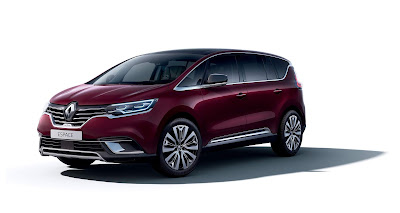
The New 2020 Renault ESPACE, significantly more complexity and innovation With more than 1.3 million vehicles sold since 1984, the Renault Espace is a famous vehicle, constantly a stage relatively revolutionary and always reevaluating itself.
- new EASY DRIVE driver-help advancements, including versatile LED MATRIX VISION - a first in the Renault's range-high pillars for increasingly effective and more secure lighting, and the Highway and Traffic Jam Companion, , level 2 of self-governing driving,
- the Renault EASY CONNECT environment, offering another experience of associated versatility with the new Renault EASY LINK interactive media framework showed on a 9.3-inch screen and has a 10.2-inch computerized "Driver Display" on the dashboard,
- MULTI-SENSE settings and the 4CONTROL edge with four directed wheels, and matched with flexible damping.
The INITIALE PARIS trim completely epitomizes this reinterpretation by offering the best of Renault's expertise. This meaningful adaptation of Renault's top-of-the-extend gives travelers an invigorating sense experience that grasps contact, hearing, smell and driving sensations.
The sophisticated materials, ergonomic changes and new technologies inside the New Espace offer drivers and passengers a best-in-class interior
worn by the INITIALE PARIS label.
Led matrix vision adaptive lighting
The New Espace uses the LED MATRIX VISION technology, a first in the Renault range. This intelligent adaptive lighting system provides more safety with better performance than traditional LED systems and greater peace of mind when driving with high beams which do not dazzle other drivers, since the beam is constantly adjusted to the traffic conditions and other motorists.
Each optical unit is made up of vertical LED segments which turn on and off automatically and separately according to
different situations.
The front camera identifies oncoming vehicles at from 550 metres and vehicles ahead at 350 metres.
The system controls each LED segment and, according to their position, creates shadows and reduce lighting density to avoid dazzling motorists ahead or oncoming vehicles and to avoid reflections from road signs.
The headlights are also adjusted when overtaking another vehicle. At the same time, they ensure maximum lighting of the rest of the road to
create optimum visibility.
Connected to the MULTI-SENSE system, the LED MATRIX VISION headlamps on the New Espace adapt when the vehicle
is in Sport mode, to ensure the best possible visibility for sporty driving.
The high beams are automatically activated with a transition phase called a “curtain effect” from 30 km/h in Sport mode, compared with 40 km/h in the other modes. The LED MATRIX VISION headlamps also increase safety and perform better than
Expanding on the achievement of the ebb and flow age's mix of bountiful measures of inside space, familiar luxuries, and Volkswagen's mark enjoyable to-drive nature, the new 2020 Passat offers a greater amount of what makes a difference—bolder structure, redesigned innovation, and upgraded access to comfort and driver-help highlights.
The 2020 Volkswagen Passat will be accessible in four trim levels and is required to start landing at U.S. Volkswagen sellers before the finish of 2019. Evaluating begins at $22,995 MSRP for the Passat S with the standard 2.0T motor and 6-speed programmed transmission. Goal for all Passat models is $920.
2020 Volkswagen Passat Exterior
For 2020, the Passat’s sheetmetal has been redesigned, giving the car a much bolder look. The sophisticated design, which carries only the roof panel from the previous car, lends the Passat a simplified elegance that helps it stand out from the rest of the midsize sedan competitors, with a straightened greenhouse and a coupe-like roofline.
Slim headlights and a dominant grille give the 2020 Passat a focused, expressive face. The powerful promise of the front end is supported by an elegant and dynamic side treatment that features a strong Tornado line. Standard 17-inch ten-spoke aluminum-alloy wheels and 215/55R17 tires give the car a more dynamic stance, while SEL models come shod with 18-inch five-spoke two tone wheels and 235/45/R18 rubber.
R-Line® models take the basic design and up the ante. The more aggressive front end treatment features a unique bumper with C-signature air intakes in gloss black and adds vertical chrome stripes to the grille. From the side, R-line models are distinguished by badging on the flitzer and black window surrounds. At the back, a rear diffuser and rear spoiler add a sporty touch. R-Line models feature striking 19-inch, two-tone, five-spoke aluminum-alloy wheels shod with 235/40R19 rubber.
Standard LED head- and taillights help the car stand out from the crowd and enhance the modern design. Passat SEL trims are further equipped with Volkswagen’s Adaptive Front-lighting System (AFS) with range control and cornering lights. A power-tilt-and-slide sunroof is standard equipment on Passat R-Line and SEL, and is optional on SE models. Prominent Passat badging, that runs the width of the decklid, finishes the car with a premium look. The Passat is available in six colors—Pure White, Reflex Silver, Platinum Grey, Deep Black Pearl, Aurora Red Chroma, and Tourmaline Blue.
The 2020 Passat remains a generously-proportioned four-door sedan. Nose to tail, it measures 193.6 inches and features a 110.4-inch wheelbase and 72.2-inch width, which allows for an exceptional 39.1 inches of rear-seat legroom. Thanks to a sophisticated overall package of aerodynamic design features, the 2020 Passat manages a low coefficient of drag (.29).
2020 Volkswagen Passat Interior
Like the exterior, the redesigned interior conveys sophistication and quality. The new cockpit incorporates a horizontal design that emphasizes the interior space; the concept is prominently illustrated by a long horizontal element that stretches the length of the dashboard, incorporating the air vents and framing a new, more contemporary instrument panel. Below, a new trapezoidal center display for the infotainment system is housed in glass, updating the look and furthering the upscale ambience.
Despite its new coupe-like styling, the 2020 Passat offers the same cabin space that helped make the outgoing model popular. Here, comfort continues to be a key strength. Base-level S models come with cloth seats in Titan Black. SE trims upgrade to Volkswagen’s V-Tex leatherette, which is offered in Titan Black, Shetland Beige, and Mauro Brown. R-Line trims also adopt V-Tex, with two color options—Titan Black and two-tone Titan Black and Shetland Beige. SEL models feature leather in the same color scheme as SE models.
The Passat offers heated front seats as standard on SE models and above, with heated outboard rear seats standard on SEL models. A powered driver’s seat with memory is featured on SE trims and above, while SEL models further upgrade to Sport Comfort seats, which bring power to the front passenger seat as well. Additionally, SE and SEL models feature a leather-wrapped multifunction steering wheel. In R-Line models, the 2020 Passat is equipped with a leather-trimmed sport steering wheel that features shift paddles.
Between the large speedometer and tachometer is color multi-function trip computer that helps monitor everything from fuel consumption to trip distance, Bluetooth® connection status for compatible devices and navigation directions (when equipped). SE trims and above feature KESSY® keyless access and push-button start, as well as dual-zone Climatronic® automatic climate control.
All 2020 Passat vehicles come standard with automatic headlights, and SE models and above feature rain-sensing windshield wipers, and an automatically dimming rearview mirror. Heated side mirrors with integrated turn signals are also standard throughout, while SEL models add a power-folding function and memory.
Fender® Premium Audio. SEL models feature the 400-watt Fender Premium Audio system with eight speakers and a separate subwoofer, allowing passengers to feel the music as if they were listening in person.
MIB II Infotainment. All 2020 Passat models feature Volkswagen’s innovative MIB II touchscreen infotainment system. The display utilizes a capacitive-touch sensor (as in smartphone and tablet technology) rather than the more common resistive touchscreens that require pressure, enabling gesture controls like swiping and even pinch-zooming.
Passat S, SE and R-Line models are equipped with the Composition Media unit, which features a glass-covered 6.3-inch capacitive touchscreen display. The infotainment system offers two USB-A ports (SE models and above receive two more charge-only ports in the rear center console), standard Bluetooth technology for compatible devices, SiriusXM® radio for a three month trial period, as well as a rearview camera. The unit has the ability to send and receive SMS text messages via Bluetooth with compatible phones and can pair two phones simultaneously. App-Connect smartphone integration for compatible devices is standard, and offers users the ability to run select smartphone apps directly on the vehicle’s display through services such as Apple CarPlay®, Android AutoTM and MirrorLink®.
Passat SEL models are equipped with the Discover Media system, which adds HD Radio and 2.5D navigation. It features one-shot voice destination entry, typed destination entry with search and auto-complete, and predicts possible destinations based on frequently used routes.
Volkswagen Car-Net®. Since its debut for the 2014 model year, Volkswagen Car-Net has allowed Volkswagen owners to get connected to their vehicles. For model year 2020, Car-Net moves into the next generation of integration, with an updated mobile app, a long list of no-charge services for five years, and new subscription options. Car-Net Services will be offered in four areas: Remote Access, Safe & Secure, Hotspot, and Guide & Inform. 2020 Passat SE models and above will be equipped with Car-Net (late availability).
Car-Net Remote Access gives owners the ability to interact with their vehicle from miles away via the mobile app. It is offered at no additional charge for five years from the date of vehicle purchase. Features include remote start and stop (if equipped), remote door lock and unlock, remote honk and flash of lights, last parked location, and remote vehicle status display, which provides information on fuel level, mileage, and door and window status.
Available later this year, VW Car-Net app for smartwatch (supports select Apple Watch® and Android Wear operating systems) allows VW customers to control a host of functions, available through the iPhone® and Android apps, directly from their wrist. Smartwatch wearers can keep tabs on their vehicle from afar, remotely locking and unlocking doors, remotely starting their vehicle, and viewing the status of doors, windows and sunroof (open or closed). These consumers can also find a parked vehicle more quickly and receive alerts with a compatible smartwatch.
Volkswagen owners with factory-installed navigation can send destinations or points of interest directly to their car from the app, helping to save time. Coming later this year, owners will also be able to connect their VW Car-Net account to compatible smart home devices to send voice commands to their vehicle to check the fuel level or remote start the engine.
Powered by Parkopedia, the Parking Information feature can help make owners’ lives easier by locating off-street parking information. Through the Navigate tab on the app, users can click the “P” icon to show available parking locations, either in the immediate vicinity or near a Point of Interest. Clicking on a specific location will display the address, hours of operation and pricing. Users can also send the location to their car’s navigation system, if so equipped, by clicking the “Send to My VW” button.
Vehicle Health Reports can provide owners easy access to diagnostic information. Reports generate automatically each month after enrollment and are sent directly to the email address in the owner’s profile; owners can also request updated reports anytime through the mobile app. When it’s time for scheduled service, Car-Net can not only notify the customer, but also provides a simple way to schedule a dealer visit.
Family Guardian services and Roadside Call Assist can provide added peace-of-mind no matter who is driving. Speed alert notifies the owner when the pre-determined maximum speed limit is exceeded. Boundary alert lets the owner know when the vehicle has traveled outside of a pre-set virtual boundary. Curfew alert notifies the owner if the vehicle is driven while curfew alert is on. Valet alert alerts if the vehicle is driven more than 0.2 miles from the valet drop-off location. The Car-Net app allows users to control who receives notifications by designating primary and secondary users, with varying levels of control and functionality for each. Notifications can come in the form of text messages, emails, or push notifications from the mobile app itself. If the vehicle is disabled, Roadside Call Assist is available at the touch of the wrench button.
The DriveView™ program is new for 2020. By enrolling in this program, Car-Net users may be eligible for discounted rates from some of the top automotive insurance companies in the country. This program can also help Car-Net users monitor their driving by tracking activities like night driving, hard braking, idle time, and excess speed. These factors all contribute to an overall driving score, which is visible within the mobile app.
Car-Net Safe & Secure is a paid subscription service that includes Information Assistance, Emergency Assistance, Automatic Crash Notification, Anti-Theft Alert, and Stolen Vehicle Location Assistance. The subscription is $99 per year before taxes and fees, and automatically renews annually at the end of the subscription term, unless cancelled. Information Assistance—accessed through the i-call button within the vehicle—allows the driver to speak to a Car-Net agent for support needs, such as points of interest and account services. Emergency Assistance can be accessed through the SOS button in the vehicle, and, if a cellular connection can be established, puts the driver in contact with the Car-Net service center, who can direct emergency responders to the vehicle’s location and notify the user’s Emergency Contact. Provided a cellular connection can be established, Automatic Crash Notification can help automatically notify an operator who can quickly contact first responders in the event of a collision. Anti-Theft Alert sends a push notification to the user if the vehicle’s anti-theft alarm is triggered, and Stolen Vehicle Location Assistance uses Car-Net to assist law enforcement with locating the vehicle in the event that it is stolen.
Car-Net Hotspot allows passengers to access the internet with up to four connected devices simultaneously, including tablets, smartphones, laptops, gaming devices, and more— at 4G LTE-enabled speed. Existing Verizon Wireless customers with an unlimited mobile data plan can simply add their Volkswagen vehicle as a new line item to their existing plan, non-Verizon customers can set up a prepaid plan for $20/month before taxes and fees.
Car-Net Guide & Inform offers an enhanced navigation and infotainment experience for VW owners with a factory-installed navigation system. Drivers can access traffic reports, fuel prices, sports scores, movie times, and weather data as part of the three-month SiriusXM Travel Link trial. Car-Net enrollment and subscription is not required.
2020 Volkswagen Passat Powertrain
The 2020 Passat is powered by Volkswagen’s 2.0-liter turbocharged and direct-injection EA888 engine, which produces 174 horsepower and 206 lb-ft of torque (22 lb-ft more than the previous Passat). The power is taken to the front wheels via a standard 6-speed automatic transmission with Tiptronic® shifting, with steering-wheel mounted shift paddles on R-Line models.
The TSI® engine features innovative solutions such as water-cooled exhaust gas routing through the cylinder head to the turbocharger (to efficiently reduce full-load fuel consumption) and a dual injection system with direct and multi-port injection. Thanks to its fully electronic coolant control system, the four-cylinder engine also offers highly efficient thermal management with a short warm-up phase; this reduces friction and decreases fuel consumption.
EPA-estimated fuel economy for the 2020 Passat is 23 mpg in city driving, 34 mpg on the highway, and 27 mpg combined.
2020 Volkswagen Passat Chassis
The Passat has been designed to give the kind of dynamic handling and precise steering that drivers have come to expect of a Volkswagen. Its front suspension features struts with lower control arms, coil springs, and an anti-roll bar. At the rear, there’s a sophisticated four-link independent layout with telescopic dampers and an anti-roll bar. The electro-mechanical power steering is weighted to provide a balance between precision at highway speeds and lower steering weight at parking speeds.
2020 Volkswagen Passat Safety
To help protect occupants, the Passat provides a combination of both passive and active safety systems. It features six airbags as standard (front and side airbags for front passengers and side curtain airbags for outboard seating positions), along with a number of electronic safety systems, such as an Anti-lock Braking System (ABS) and Electronic Stability Control (ESC).
A standard feature on the 2020 Passat is Volkswagen’s Automatic Post-Collision Braking System. This builds on the premise that a collision is rarely a single, instantaneous action, but rather a series of events that follow the initial impact—the most significant of which can cause additional collisions. The Automatic Post-Collision Braking System helps address this, in certain crash scenarios, by applying the brakes when a primary collision is detected by the airbag sensors, thus potentially reducing residual kinetic energy and, in turn, the chance of additional damage.
The Passat also includes Volkswagen’s Intelligent Crash Response System that shuts off the fuel pump, unlocks the doors, and switches on the hazard lights if the car is involved in certain types of collisions.
All Passat models feature a standard rearview camera.
To meet the demands of American drivers, the 2020 Passat offers a comprehensive suite of driver-assistance technology. Available features include: Forward Collision Warning and Autonomous Emergency Braking with Pedestrian Monitoring (Front Assist); Blind Spot Monitor Rear Traffic Alert; Adaptive Cruise Control (ACC); Lane Keeping System (Lane Assist); Park Distance Control; Parking Steering Assistant (Park Assist); and High Beam Control (Light Assist).
Front Assist, standard on all models, is intended to warn drivers of potential frontal collisions (Forward Collision Warning) with vehicles and pedestrians, and in some cases provide automatic braking assistance (Autonomous Emergency Braking).
Within physical system limits, Forward Collision Warning warns the driver of potential critical front-end collision situations, both acoustically and visually by a warning symbol in the instrument cluster if the car is traveling above 18 mph. Furthermore, an automatic jolt of the brakes can warn the driver of the danger. If the driver fails to brake, or if the car is traveling below 18 mph, Autonomous Emergency Braking is activated to help slow the vehicle. If the brake pedal is applied but the driver brakes too lightly, the brake pressure is increased by the system (Braking Support).
Blind Spot Monitor is standard on all Passat models. Blind Spot Monitor uses two radar sensors at the rear of the vehicle to scan the approaching traffic and is intended to warn drivers of the presence of other vehicles in adjacent lanes. If the driver uses the turn signal to indicate a lane change while a vehicle is detected in a blind spot, the system utilizes a flashing LED symbol in the outer area of the side mirrors. Even if the driver does not use a turn signal, the LED symbol in the mirror will illuminate if a vehicle is detected in the blind spot. The system is designed to help alert drivers in specific situations; stationary objects or oncoming vehicles do not trigger warnings, nor do vehicles more than one lane across away from the vehicle.
If combined with Lane Assist (SE models and above, see below) the system not only warns the driver with the flashing LED symbol if a vehicle is detected in the blind spot, but within system limits, it can also countersteer to help keep the car in the lane even if the turn signal is on. If the driver still tries to steer out of the lane, the system will warn with an additional vibration of the steering wheel.
The Rear Traffic Alert system, standard on all models is intended to detect vehicles approaching from the side that may be difficult for the driver to see while reversing. The system offers a 180-degree view of the back of the car with a range of 65 feet, and will present a visual and an acoustic warning, if a potential collision with a crossing vehicle is detected. If the driver does not react, the system can apply the brakes to help mitigate and, in the best case, can prevent a collision. The system is activated by putting the car in reverse.
Adaptive Cruise Control (ACC), standard on SE models and above, uses a forward facing radar to maintain a set speed while helping maintain a set distance to the vehicle in front. The driver sets the speed and the desired spacing via buttons on the multifunction steering wheel and can further use those buttons to adjust and cancel the ACC function while the accelerator can be used to override the ACC function. Pressing the brakes always cancels the ACC function. All ACC-related system messages appear in the central multifunction display.
When the roadway ahead of the vehicle is clear, the system maintains the set speed. Passat models fitted with ACC can match a vehicle in front and slow down as the car ahead slows. As the vehicle ahead slows, ACC on the Passat will disengage below 12 mph and request the driver to take over control.
Lane Keeping System (Lane Assist) is standard on SE models and above. When driving above 40 mph, if the system’s camera recognizes visible lane markings and, using a special algorithm, calculates that the vehicle is unintentionally straying from its lane without using a turn signal, Lane Assist actively countersteers to help keep the vehicle in the lane If the driver takes his or her hands off the wheel for a defined period of time, the system provides an audible warning and a visual signal in the instrument cluster, asking the driver to take over.
The system will not engage if it cannot properly detect lane markings. If the turn signal has been set before crossing a lane marking, the Lane Assist system will not engage or give a warning. The driver can override the system at any time by applying minimal force to the steering wheel.
Park Distance Control, equipped on SEL models, uses ultrasonic sensors located in the front and rear bumpers to monitor a range of up to approximately five feet in front or behind the vehicle. The system may activate below 9 mph and helps provide guidance when parking or in tight spaces. The system has audible and visual warnings when the car starts to approach parked cars or static objects of sufficient size from the front or rear.
Parking Steering Assistant (Park Assist) is included on SEL models. This system can automatically steer the car into parallel and perpendicular parking spaces (the latter in reverse). While driving below 25 mph, pressing the Park Assist button in the center console will activate the system to scan the left and right sides of the vehicle for parking spots. By using the turn signal indicator, the driver can indicate which side of the road they would like to park. When the system detects a space, “Parking Space Found” will appear in the multifunction display. The driver only needs to activate the accelerator pedal and brake once a gear is selected, as Park Assist can automatically help steer the vehicle into the parking space. The driver can override or deactivate the steering assistance at any time by turning the steering wheel, or pressing the button.
High Beam Control (Light Assist) automatically switches on the headlamp high beams above 37 mph on dark or poorly lit roads, if there is no oncoming traffic detected. Below 18 mph, the high beams automatically switch off.
2020 Volkswagen Passat Warranty & Maintenance
Every 2020 Passat comes with a Bumper-to-Bumper Limited Warranty and Carefree Maintenance Program. The warranty provides coverage for four years or 50,000-miles (whichever occurs first), and can be transferred to a subsequent owner throughout the remainder of its duration. The Carefree Maintenance Program provides scheduled maintenance services for 2 years or 20,000 miles (whichever occurs first) at no additional charge, and can be transferred to a subsequent owner throughout the remainder of its duration.
The Insurance Institute for Highway Safety’s side crash test has led to lifesaving improvements in occupant protection since it was introduced in 2003.
There’s just one problem: The program has been so successful that the current side ratings no longer help consumers distinguish among vehicles or point the way toward further improvements.
An updated test should help. IIHS researchers and engineers have been weighing potential changes. A new test program with a higher impact speed and a heavier, more realistic movable barrier representing a more modern striking vehicle is expected to be launched next year.
In addition to identifying things that should change, the research has also clarified what aspects of the current evaluation work well.
Measures collected from the test were found to correlate closely with fatality risk.
Thus, the new test will likely use the same dummies and collect similar information as the current one.
“This is an opportunity to build on what we’ve learned in more than 15 years of side testing,” says IIHS Senior Research Engineer Becky Mueller.
“We’ll update the things that need updating, but we don’t need to throw out the things that still work well.”
Crash test history
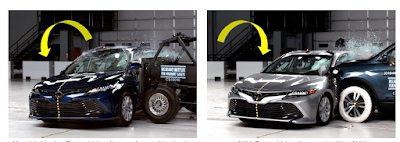
When IIHS developed its current side crash test, it filled a need that had emerged with the rise in popularity of SUVs. At the time, the National Highway Traffic Safety Administration (NHTSA) was conducting side tests as part of its consumer information program, using a movable barrier with the height of a car.
That test, still part of NHTSA’s ratings, doesn’t reflect the much greater risk of head injury from impacts with taller vehicles.
The IIHS test proved more challenging than the NHTSA test because the Institute’s movable barrier mimicked the height and shape of the front end of the typical SUV or pickup on the road at the time.
IIHS also used dummies representing a small woman or 12-year-old child. The combination of these two things meant that the barrier struck the vehicle at about the height of the dummies’ heads.
To achieve a good rating in the test, automakers strengthened side structures and equipped vehicles with head-protecting side airbags ahead of a federal regulation that made them essentially mandatory. Only about 1 in 5 vehicles tested earned good ratings in the beginning.
Today, 99 percent of rated vehicles earn a good rating, and the remainder are acceptable.
NHTSA barrier, shown in yellow, superimposed over the taller IIHS barrier
Initial two Volkswagen Beetles sold in America were imported in 1949 by Ben Pon, propelling U.S. offers of the overall great
In 1949, Dutch representative Ben Pon landed in New York with two Volkswagen Type 1 vehicles—later to be known as the Beetle—in one of the main endeavors to offer moderate little vehicles to Americans. In excess of 17 million vehicles later, Volkswagen commends 70 years in America with a drive through a world of fond memories during the LA Auto Show.
2019 Volkswagen Jetta and 1982 VW Jetta exterior interior video
From the Beetle and the Bus, through the Rabbit, Jetta and GTI, and to the Tiguan and Atlas, Volkswagen has constantly kept up its status as "the individuals' vehicle"— conveying extraordinary incentive in transportation, however enjoyable to-drive autos with a one of a kind style.
"In the course of recent years, Volkswagen has developed from two Beetles to a critical piece of American history," said Scott Keogh, President and CEO, Volkswagen of America, Inc. "As we look forward to driving our organization toward greater objectives like our cutting edge electric vehicles, we will consistently recall where we began."
1973 VW Squareback, VW 2019 Golf Alltrack, and VW 2019 Tiguan video
While Pon battled in his strategic—took him two months in America to sell the two vehicles he brought over—Americans before long warmed to the charms of the Beetle.
Volkswagen of America was set up in 1955 to sort out sellers and give parts and administration, and in 1959, the brand ran its first famous "Think Small" advertisements touting the advantages of the air-cooled, simple to-look after Beetle.
1967 VW Type 2 21 Window Bus and 2019 VW Atlas video
The Beetle, Bus and more specialty models like the Karmann Ghia were basic pieces of '60s culture, from Woodstock to Hollywood.
Volkswagen reacted to request by adding to its model line, with vehicles like the Dasher and Squareback. The '70s brought requests for significantly increasingly proficient models, and the original Scirocco joined the lineup, trailed by the Golf with its American name—the Rabbit.
1984 volkswagen GTI Rabbit and 2019 Volkswagen GTI Rabbit video
Volkswagen fabricated its first U.S. plant in Westmoreland, Pennsylvania in 1978 and in the end gathered more than 1.1 million Rabbits there.
That plant additionally delivered Volkswagen's first American lively vehicle, the Rabbit GTI, a model that would prevail upon ages of fans and generate a few hot-incubate contenders.
All through the 1980s and '90s, Volkswagen offered an expanding level of modernity and refinement in models like the Jetta and Passat.
As retro culture came into vogue during the '90s, Volkswagen demonstrated the Concept 1, a reimagination of the great Beetle. It was so generally welcomed that the brand propelled the New Beetle in 1998.
With the opening of the Chattanooga plant in 2011, Volkswagen of America started to move considerably more creation and structure of its models to North America.
The new 2020 Passat, which goes at a bargain this month, will join the Atlas and up and coming Atlas Cross Sport as Volkswagen models amassed in America.
Chattanooga will likewise collect the eventual fate of Volkswagen in America when it dispatches electric vehicle creation dependent on the overall MEB stage throughout the following not many years.
The 70th commemoration drive during the LA Auto Show incorporates the accompanying models and their advanced partners:















 Posts
Posts

